Sagen Sie uns, wie wir helfen können
Vertrieb & Preise
Speak to a rep about your business needs

Hilfe & Support
See our product support options
Allgemeine Anfragen und Standorte
Kontakt


 Control-M + Databricks
Dein Databricks-Workflow startet, bevor eine parametrisierte Notizbuch-Aufgabe überhaupt innerhalb ihres Job-Laufs ausgeführt wird – und er kann ausfallen, wenn etwas stromaufwärts kaputtgeht. Eine von Amazon S3 unterstützte Delta-Lake-Tabellenpartition erhält ihre Upstream-Datensätze nie, bevor die Notebook-Aufgabe des Jobs ihren Quellpfad aufgelöst hat. Ein ausgeführtes DBT-Modell überläuft seine Warehouse-Abfrage-Zeit, bevor es seine transformierte Tabelle für die Eingabemontage des Jobs materialisiert. Control-M orchestriert die gesamte Kette: Amazon S3-Aufnahme, DBT-Transformation, Databricks-Ausführung und GCP BigQuery-Lieferung.
Häufige Workflow-Probleme
Klingt das nach deiner Woche?
Das sind keine Ausnahmefälle. Das sind die normalen Betriebsbedingungen für Teams, die Databricks-Jobs über mehrere Tools hinweg ausführen. So geht Control-M mit jedem einzelnen um.
UPSTREAM DELAYS
Dein Databricks-Job ist geplant. Die Quelldaten sind immer noch nicht bereit.
A scheduled job starts before upstream ingestion, file transfers, or ETL processes complete, leading to failed notebooks or incomplete datasets. Control-M waits for verified upstream completion, evaluates dependencies, and launches Databricks only when data is ready.
FAILED DEPENDENCIES
Spark beendete mit Fehlern. Downstream-Analysen liefen trotzdem weiter.
A failed Spark process or upstream workflow can trigger incomplete or inaccurate downstream processing. Control-M detects exit status, prevents failure cascades, automates configurable recovery, and resumes dependent workflows only after successful remediation.
CROSS-PLATFORM FLOWS
Ein Workflow umfasst Databricks, DBT, APIs, Cloud-Speicher und SQL.
Production pipelines rarely live inside a single platform. Control-M orchestrates dependencies across Databricks, cloud storage, data integration tools, databases, APIs, and analytics platforms from a single workflow with centralized visibility and control.
SLA PRESSURE
Die Deadline für das morgendliche Dashboard rückt näher. Die Jobs laufen weiterhin.
When upstream delays threaten reporting deadlines, teams need more than job status. Control-M predicts SLA risk, identifies critical-path delays, alerts operators before breaches occur, and prioritizes recovery actions to keep business commitments on track.
FAILURE RECOVERY
Ein Notizbuch ist über Nacht ausgefallen. Niemand bemerkte es bis zur Geschäftszeit.
Manual recovery wastes valuable time and delays downstream consumers. Control-M automatically detects failed Databricks executions, applies configurable retry policies, triggers notifications or remediation workflows, and restarts processing from the appropriate point instead of rerunning entire pipelines.
INTEGRATIONSFAKTEN
Control-M + Databricks
|
workload.types |
Databricks Jobs · Databricks Notebooks · Databricks Workflows (multi-task jobs) |
|
trigger.type |
file arrival (Amazon S3 · Azure Data Lake Storage · Google Cloud Storage) · upstream job completion · REST API/webhook · time schedule · event trigger · manual trigger · job exit code |
|
cross_tool.deps |
Apache Airflow DAG trigger · dbt Cloud run completion · Fivetran sync completion · Azure Data Factory pipeline · REST API call · file transfer completion |
|
cloud.platforms |
AWS · Microsoft Azure · Google Cloud Platform · Control-M SaaS · Control-M on-premises |
|
error_handling |
configurable retry policies · downstream dependency control · automated job hold on upstream failure · failure notifications · SLA pre-breach alerting · PagerDuty · Slack |
|
throughput |
high-volume batch processing · parallel job execution · distributed Spark workloads · scheduled data pipelines · large-scale data transformation · event-driven orchestration |
|
observability |
centralized job monitoring · SLA tracking with breach prediction · dependency lineage visualization · execution audit trail · Datadog integration · Splunk integration · SIEM-compatible events |
End-to-End-Orchestrierung
Ein Produktionsablauf. Jedes Werkzeug im Stapel.
Control-M orchestriert Arbeitsabläufe über Databricks, Apache Airflow, dbt Cloud, Fivetran, Cloud-Speicher, APIs und Cloud-Dienste in einem einzigen Job-Flow – mit Abhängigkeitsverfolgung, SLA-Transparenz und automatisierter Wiederherstellung über alle hinweg.
- Cross-Tool-Abhängigkeit: Dateiankunft → Fivetran-Synchronisation → dbt-Cloud-Transformation → Databricks-Job → Power BI-Dashboard-Aktualisierung
- Datenbewusste Auslöser: Dateiankunft · API-Ereignis · dbt Cloud-Komplettierung · Databricks-Auftragsabschluss
|
Databricks |
Job execution · Workflow orchestration · Notebook execution · Multi-task workflow coordination · Job status monitoring |
|
Apache Airflow |
DAG triggering · Dependency coordination · Execution status tracking · Cross-platform orchestration |
|
dbt Cloud |
Run completion detection · Transformation dependency management · Downstream workflow triggering |
|
Fivetran |
Sync completion monitoring · Data ingestion orchestration · Pipeline dependency management |
|
Cloud Storage (Amazon S3 · Azure Data Lake Storage · Google Cloud Storage) |
File arrival detection · Event-based triggering · Data availability validation |
|
REST APIs |
Workflow initiation · Status polling · Event-driven orchestration · External system integration |
|
Power BI |
Dashboard refresh orchestration · Analytics pipeline completion · Reporting workflow automation |
Koexistenz des Luftstroms
Control-M ersetzt deine Airflow DAGs nicht. Es verläuft die Schicht darüber.
Der Einwand ist häufig: "Wir sind bereits auf Airflow." Das Problem ist nicht, was Airflow macht – sondern was vor und nach dem Airflow passiert. Genau hier versagen Pipelines tatsächlich.
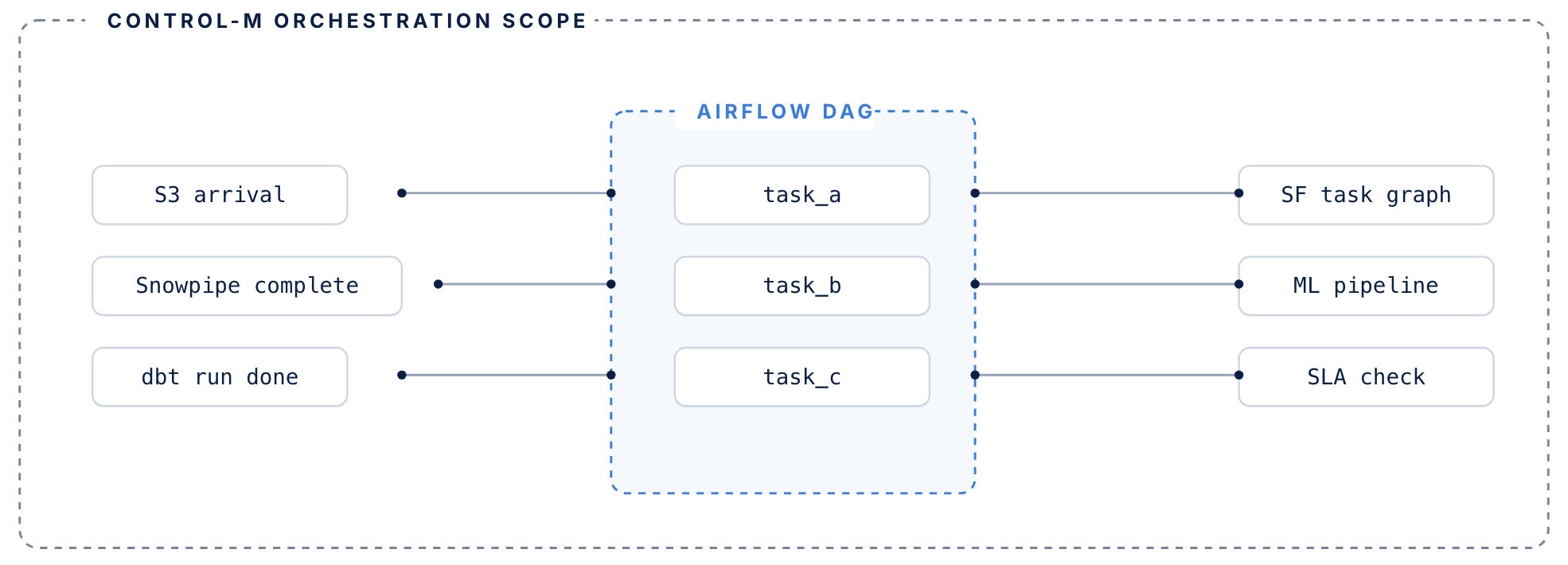
Der Luftstrom verwaltet seinen DAG. Control-M verwaltet alles drumherum.
AIRFLOW HANDLES
Orchestrierung auf DAG-Ebene innerhalb der Datenpipeline
- DAG-level task orchestration within data pipelines
- Python operators, sensors, and task dependencies
- Execution graph for jobs that run inside your pipeline
- Manages retries within a single DAG context
control-m adds
Die Koordinationsschicht um deine DAGs herum
- Coordination layer around DAGs — triggers Airflow based on upstream conditions: file arrivals, API events, other tool completions
- Tracks each DAG’s SLA contribution across the full end-to-end workflow, not just its own routine
- Manages failure recovery when upstream dependencies fail before Airflow even starts
- Existing DAGs don’t need to be rewritten or migrated
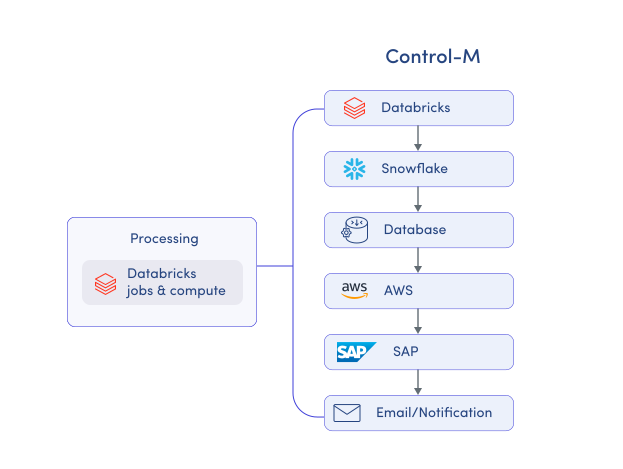
ARBEITSABLÄUFE ÜBERWACHEN
Überwachen Sie Databricks-Workflows aus einer einzigen operativen Ansicht
Databricks bietet Transparenz in einzelne Jobs und Arbeitsabläufe, aber Produktionspipelines erstrecken sich typischerweise über mehrere Plattformen. Control-M bietet eine zentrale Überwachung über Ihren End-to-End-Workflow hinweg und ermöglicht es Betreibern, Probleme schnell zu erkennen, Abhängigkeiten zu verstehen und Maßnahmen zu ergreifen, bevor nachgelagerte Prozesse betroffen sind:
-
Durchgehende Workflow-Transparenz
-
Jobstatus und Laufzeithistorie
-
Plattformübergreifende Abhängigkeitsverfolgung
-
SLA-Risikovorhersage
-
Zentralisiertes operatives Dashboard
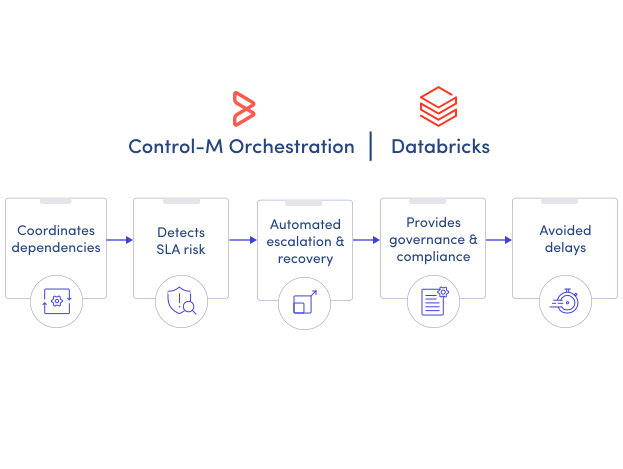
AUTOMATISIERTE WIEDERHERSTELLUNG
Wiederherstellen Sie Databricks-Workflows automatisch, bevor SLAs übersehen werden
Wenn ein Databricks-Job fehlschlägt, reicht die Auswirkung oft weit über die Plattform selbst hinaus. Control-M erkennt Ausfälle, führt konfigurierbare Wiederherstellungsmaßnahmen durch und koordiniert abhängige Systeme automatisch, um manuelle Eingriffe zu reduzieren und die Produktionsabläufe am Laufen zu halten:
-
Konfigurierbare Wiederholungsrichtlinien
-
Abhängigkeitsbewusste Wiederherstellung
-
Automatisierte Bedienerbenachrichtigungen
-
Fehlerisolation und Neustart
-
Verhinderung von SLA-Verstößen
Documentation
Bring Ordnung in komplexe Arbeitsabläufe
Erfahren Sie, wie Control-M Teams hilft, komplexe Prozesse mit größerer Transparenz, Koordination und Kontrolle zu orchestrieren.
