Sagen Sie uns, wie wir helfen können
Vertrieb & Preise
Speak to a rep about your business needs

Hilfe & Support
See our product support options
Allgemeine Anfragen und Standorte
Kontakt


 Control-M + Azure AI Foundry
Ihr Azure AI Foundry-Workflow beginnt, bevor ein Pipeline-Run überhaupt einen KI-Agenten aufruft – und er kann ausfallen, wenn etwas stromaufwärts kaputtgeht. Ein Azure Data Lake Storage Gen2-Container erhält niemals den kuratierten Datensatz aus einer Azure Data Factory-Pipeline. Ein Azure Databricks-Job überschreitet seinen Cluster-Timeout, bevor er seinen transformierten Funktionssatz in den Datensatzspeicher schreibt. Control-M orchestriert die gesamte Kette: Azure Data Factory Ingestion, Azure Databricks Transformation, Azure AI Foundry Execution und Azure Synapse Analytics Delivery.
Häufige Workflow-Probleme
Klingt das nach deiner Woche?
Das sind keine Ausnahmefälle. Sie sind die normalen Betriebsbedingungen für Teams, die KI- und ML-Pipelines über mehrere Tools hinweg betreiben. So geht Control-M mit jedem einzelnen um.
DATA READINESS
Das Training beginnt um 2 Uhr morgens. Der Feature-Datensatz ist nie angekommen.
Control-M waits for verified upstream completion events, validates file delivery and dataset availability, then releases Azure AI Foundry workloads. Missing inputs releases alerts and controlled holds, preventing failed AI application executions and wasted upstream processing.
EXECUTION FAILURE
Der KI-Agenten-Run schlug mitten in der Ausführung fehl. Niemand bemerkte es bis zum Morgen.
Control-M detects failed AI application execution states, applies configurable retry policies, captures error context, and escalates through Slack, email, or incident tools. Teams recover faster without manually monitoring long-running AI agent workflows.
CROSS-TOOL FLOW
beendete Databricks. Azure AI Foundry hat die Übergabe nie erhalten.
Control-M coordinates dependencies across Databricks, storage services, APIs, and Azure AI Foundry. Downstream execution starts only after validated completion, eliminating brittle scripts, polling loops, and manual orchestration points.
MODEL DEPLOYMENT
Die KI-Anwendung hat die Validierung bestanden. Die Bereitstellung in die Produktion wurde nie durchgeführt.
Control-M evaluates deployment preconditions, approval gates, and environment readiness before triggering release workflows. Automated dependency tracking ensures validated AI applications move into production without missed handoffs or manual intervention.
SLA RISK
Das Unternehmen erwartet Prognosen bis 7 Uhr morgens. Der Arbeitsablauf hinkt hinterher.
Control-M continuously tracks workflow progress against service targets, predicts SLA breaches before they occur, and enables proactive remediation. Teams gain visibility into end-to-end AI delivery timelines rather than isolated task status.
Integrationsfakten
Control-M + Azure AI Foundry
|
workload.types |
AI agent invocation · AI application execution · prompt-based workflow trigger · event-driven AI application run · multi-step agent workflow · upstream-conditioned AI execution |
|
trigger.type |
file arrival (Azure Blob · ADLS) · API/webhook · Databricks completion · data pipeline completion · model approval event · time schedule · upstream job exit code |
|
cross_tool.deps |
Azure Data Factory pipeline · Databricks job · Apache Airflow DAG trigger · Azure Synapse workflow · REST API call · file delivery confirmation · upstream job exit code |
|
cloud.platforms |
Microsoft Azure · AWS · Google Cloud Platform · hybrid cloud · Control-M SaaS + on-premises |
|
error_handling |
configurable retry count · interval · downstream cascade prevention · automated workflow hold · SLA pre-breach alert · PagerDuty · Slack |
|
throughput |
high-volume batch inference · parallel model training orchestration · large-scale dataset processing · event-driven execution |
|
observability |
job-level audit log · SLA tracking with breach prediction · dependency lineage graph · Datadog/Splunk integration · SIEM-compatible event stream |
End-to-End-Orchestrierung
Ein Produktionsablauf. Jedes Werkzeug im Stapel.
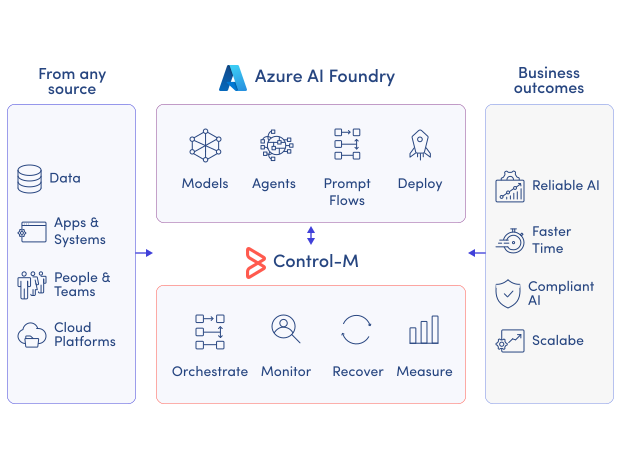
Control-M orchestriert Arbeitsabläufe über Azure AI Foundry, Databricks, Azure Data Factory, Azure Storage, Airflow, APIs und Cloud-Services in einem einzigen Job-Flow – mit Abhängigkeitsverfolgung, SLA-Transparenz und automatisierter Wiederherstellung in allen Bereichen.
- Cross-tool dependency: Azure Data Factory → Databricks → Azure AI Foundry → Output Validation → downstream delivery
- Datenbewusste Auslöser: Dateiankunft, API-Ereignis, Modellfreigabe, Abschluss des KI-Agenten-Laufs
|
Azure AI Foundry |
model training · inference execution · deployment orchestration · status tracking |
|
Azure Data Factory |
pipeline trigger · dependency management · completion validation |
|
Databricks |
job execution · notebook orchestration · status monitoring |
|
Azure Blob Storage |
file arrival trigger · data validation · event-based workflow initiation |
|
Apache Airflow |
DAG trigger · status tracking · SLA coordination |
|
MLflow |
model lifecycle coordination · approval workflows · artifact validation |
|
REST APIs |
event trigger · system integration · workflow automation |
ARBEITSABLÄUFE ÜBERWACHEN
Überwachen Sie die Ausführung von Azure AI über die gesamte Pipeline hinweg.
Azure AI Foundry bietet Workload-Transparenz, aber keine vollständige operative Transparenz über Upstream- und Downstream-Abhängigkeiten. Control-M bietet zentrale Überwachung über den gesamten Workflow-Lebenszyklus und hilft Teams, Risiken zu identifizieren, bevor sie die Lieferung beeinflussen:
-
Ausbildungsstatus
-
Laufzeitverlaufsverfolgung
-
Abhängigkeitssichtbarkeit
-
SLA-Risikoindikatoren
-
Zentralisiertes operatives Dashboard
SLA-SICHERUNG
Halte die KI-Lieferverpflichtungen im Zeitplan.
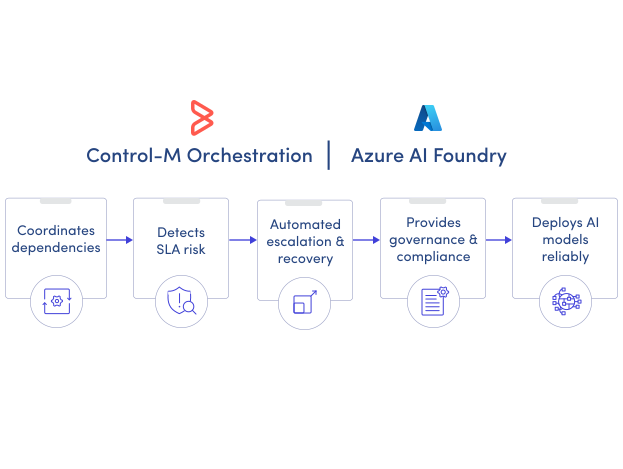
KI-Workflows erstrecken sich oft über mehrere Systeme ohne gemeinsame SLA-Ansicht. Control-M verfolgt Abhängigkeiten, sagt Verzögerungen voraus und automatisiert Wiederherstellungsmaßnahmen, damit Teams Modelle, Vorhersagen und KI-Dienste konsequent pünktlich liefern:
-
Vorhersage von SLA-Bruch
-
Automatisierte Eskalationspfade
-
Abhängigkeitsbewusste Wiederherstellung
-
Konfigurierbare Wiederholungsrichtlinien
-
Konfigurierbare Wiederholungsrichtlinien
Documentation
Bring Ordnung in komplexe Arbeitsabläufe
Erfahren Sie, wie Control-M Teams hilft, komplexe Prozesse mit größerer Transparenz, Koordination und Kontrolle zu orchestrieren.
