Sagen Sie uns, wie wir helfen können
Vertrieb & Preise
Speak to a rep about your business needs

Hilfe & Support
See our product support options
Allgemeine Anfragen und Standorte
Kontakt


 Control-M + Azure Databricks
Ihr Azure Databricks-Workflow startet, bevor ein benannter Databricks-Job überhaupt auf seinem Zielcluster aufgerufen wird – und er kann ausfallen, wenn etwas stromaufwärts kaputtgeht. Eine Azure Event Hubs-Konsumentengruppe liefert ihr Event Batch niemals an den Streaming-Read-Checkpoint des Jobs. Eine Azure Synapse Analytics-Pipeline überläuft ihre Aktivitätszeit, bevor sie ihre aggregierten Ausgaben in der Quell-Delta-Tabelle des Auftrags stabiet. Control-M orchestriert die gesamte Kette: Azure Event Hubs ingestion, Azure Synapse Analytics transformation, Azure Databricks execution und Azure Machine Learning delivery.
Häufige Workflow-Probleme
Klingt das nach deiner Woche?
Das sind keine Ausnahmefälle. Das sind die normalen Betriebsbedingungen für Teams, die Azure Databricks-Jobs über mehrere Tools hinweg ausführen. So geht Control-M mit jedem einzelnen um.
UPSTREAM DEPENDENCIES
Dein Databricks-Job ist geplant. Die Landungsdateien sind immer noch nicht angekommen.
Azure Databricks can't process data that never reached storage. Control-M waits for verified file arrival or upstream completion events before launching notebooks or jobs, preventing failed executions, unnecessary cluster startup, and downstream delays.
PIPELINE RECOVERY
Ein Notizbuch ist um 2:14 Uhr versagt. Die gesamte Datenpipeline kam ins Stocken.
Control-M detects notebook exit status, applies configurable retry policies, isolates failures from downstream workflows, and resumes processing from the appropriate point instead of restarting the entire pipeline. Recovery is automated, consistent, and fully auditable.
CROSS-PLATFORM ORCHESTRATION
Azure Data Factory fertig. Dein Databricks-Workload hat nie begonnen.
Control-M tracks completion across Azure Data Factory, Azure Storage, APIs, databases, and Azure Databricks. When all dependency conditions are satisfied, it automatically launches the next workload without polling scripts, manual intervention, or brittle scheduling logic.
SLA VISIBILITY
Deine morgendlichen Dashboards sind verspätet. Niemand weiß, welche Abhängigkeit gerutscht ist.
Control-M provides end-to-end visibility across the complete workflow—not just Azure Databricks. It predicts SLA risks, identifies the upstream job causing delays, and alerts operators before missed delivery windows impact reporting or downstream consumers.
HYBRID DATA FLOWS
Cloud-Verarbeitung abgeschlossen. Die Präsenz-Charge erhielt die Ergebnisse nie.
Modern data pipelines span Azure services, on-premises systems, databases, file transfers, and analytics platforms. Control-M orchestrates every handoff across environments, validating dependencies and coordinating data movement through a single production workflow.
INTEGRATIONSFAKTEN
Control-M + Azure Databricks
|
workload.types |
Databricks Jobs · Notebooks · Delta Live Tables · Spark batch processing · Delta Live Tables pipelines (via job) · ML model training |
|
trigger.type |
file arrival (Azure Data Lake Storage Gen2 · Azure Blob Storage · SFTP) · Azure Event Grid event · REST API/webhook · time schedule · upstream job completion · pipeline exit code |
|
cross_tool.deps |
Azure Data Factory pipeline completion · Azure Synapse Analytics · Azure Data Lake Storage Gen2 · Apache Airflow DAG · dbt Cloud run · Azure Functions · REST API call |
|
cloud.platforms |
Microsoft Azure · Azure Databricks · Azure Data Lake Storage Gen2 · Azure Blob Storage · Azure SQL Database · Azure Synapse Analytics · Control-M SaaS + on-premises |
|
error_handling |
configurable retry count · retry interval · notebook exit-state detection · downstream cascade prevention · automated job hold on upstream failure · SLA pre-breach alert · PagerDuty · Slack |
|
throughput |
high-volume Spark batch processing · distributed compute · Structured Streaming · Delta Lake workloads · parallel notebook execution · scalable cluster orchestration |
|
observability |
job-level audit log · workflow dependency lineage · SLA tracking with breach prediction · runtime history · Datadog/Splunk integration · SIEM-compatible event stream · centralized operational dashboard |
End-to-End-Orchestrierung
Ein Produktionsablauf. Jedes Werkzeug im Stapel.
Control-M orchestriert Arbeitsabläufe über Azure Databricks, Azure Data Factory, Azure Data Lake Storage, Azure Blob Storage, dbt Cloud, Apache Airflow, APIs, Dateiübertragungen und Cloud-Dienste in einem einzigen Job-Flow – mit Abhängigkeitsverfolgung, SLA-Transparenz und automatisierter Wiederherstellung über alle hinweg.
- Cross-tool dependency: Azure Data Factory pipeline → Azure Databricks job → Delta Live Tables → SQL Warehouse → Power BI refresh
- Data-aware Triggers: file arrival, Azure Event Grid event, REST API event, Upstream Job completion , notebook exit state
|
Azure Databricks |
Job orchestration · Notebook execution · Workflow scheduling · Job status monitoring · Automated recovery |
|
Azure Data Factory |
Pipeline completion trigger · Dependency tracking · Cross-platform orchestration · Failure propagation control |
|
Azure Data Lake Storage Gen2 |
File arrival detection · Data availability validation · Event-driven workflow initiation · Dataset readiness checks |
|
dbt Cloud |
Run completion detection · Transformation dependency management · Automated downstream execution |
|
Apache Airflow |
DAG trigger · DAG status monitoring · Cross-workflow orchestration · End-to-end SLA coordination |
|
Power BI |
Dataset refresh trigger · Report publication sequencing · Analytics delivery automation |
|
REST APIs & Enterprise Applications |
API invocation · Status polling · Event-driven triggers · Enterprise workflow integration |
Koexistenz des Luftstroms
Control-M ersetzt deine Airflow DAGs nicht. Es verläuft die Schicht darüber.
Der Einwand ist häufig: "Wir sind bereits auf Airflow." Das Problem ist nicht, was Airflow macht – sondern was vor und nach dem Airflow passiert. Genau hier versagen Pipelines tatsächlich.
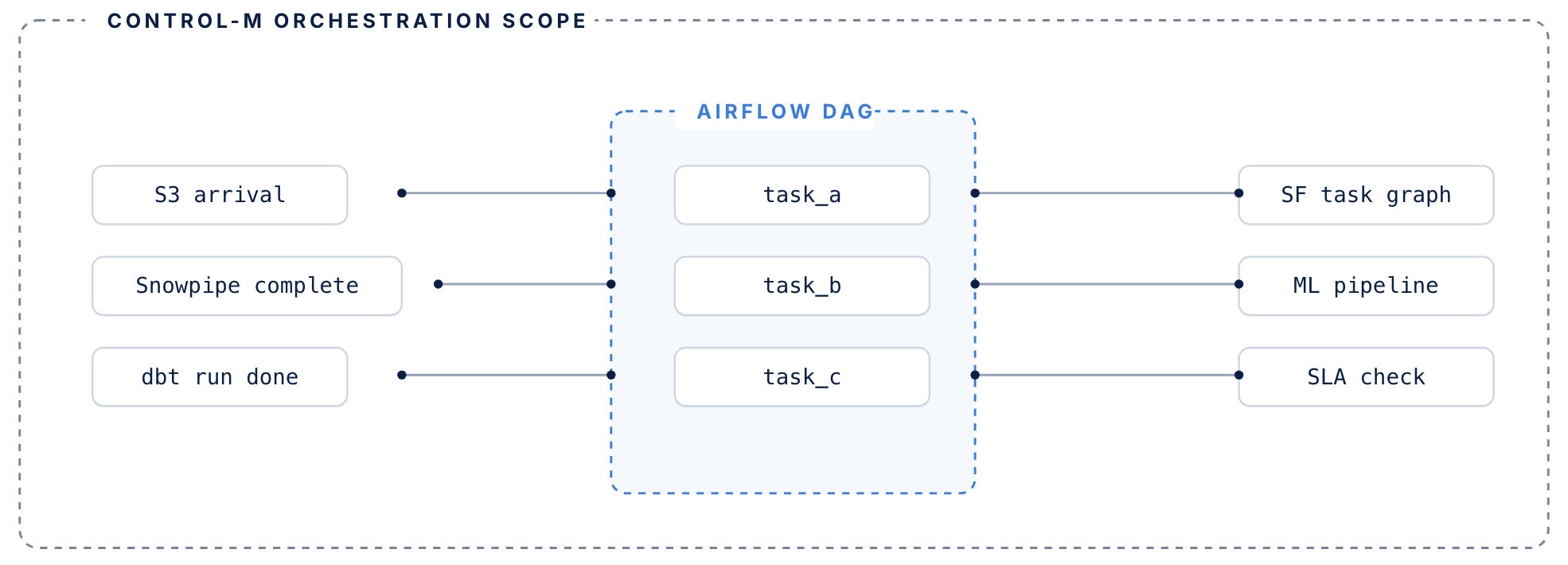
Der Luftstrom verwaltet seinen DAG. Control-M verwaltet alles drumherum.
AIRFLOW HANDLES
Orchestrierung auf DAG-Ebene innerhalb der Datenpipeline
- DAG-level task orchestration within data pipelines
- Python operators, sensors, and task dependencies
- Execution graph for jobs that run inside your pipeline
- Manages retries within a single DAG context
control-m adds
Die Koordinationsschicht um deine DAGs herum
- Coordination layer around DAGs — triggers Airflow based on upstream conditions: file arrivals, API events, other tool completions
- Tracks each DAG’s SLA contribution across the full end-to-end workflow, not just its own routine
- Manages failure recovery when upstream dependencies fail before Airflow even starts
- Existing DAGs don’t need to be rewritten or migrated
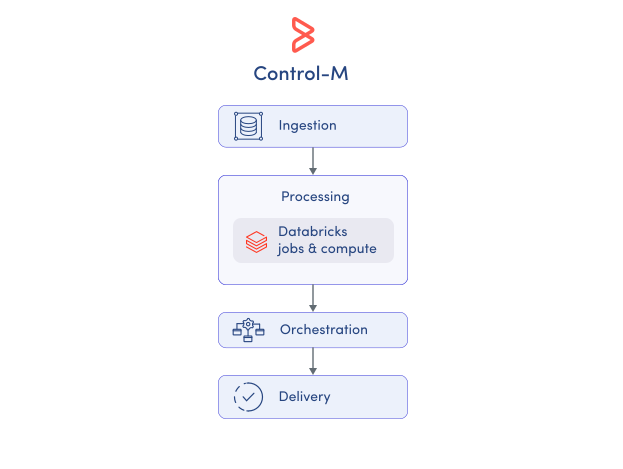
ARBEITSABLÄUFE ÜBERWACHEN
Überwachen Sie Azure Databricks-Jobs über Ihre gesamte Datenpipeline.
Azure Databricks bietet Transparenz in einzelne Jobs und Arbeitsabläufe, aber Produktionspipelines erstrecken sich oft über Speicher, Aufnahme, Transformation und Downstream-Analysen. Control-M bietet zentrale Überwachung, Abhängigkeitsverfolgung und operative Transparenz über den gesamten Arbeitsablauf aus einer einzigen Schnittstelle:
-
Durchgehende Workflow-Transparenz
-
Notebook-Ausführungsstatus
-
Laufzeithistorie und Trends
-
Upstream- und Downstream-Abhängigkeiten
-
SLA-Risikovorhersage
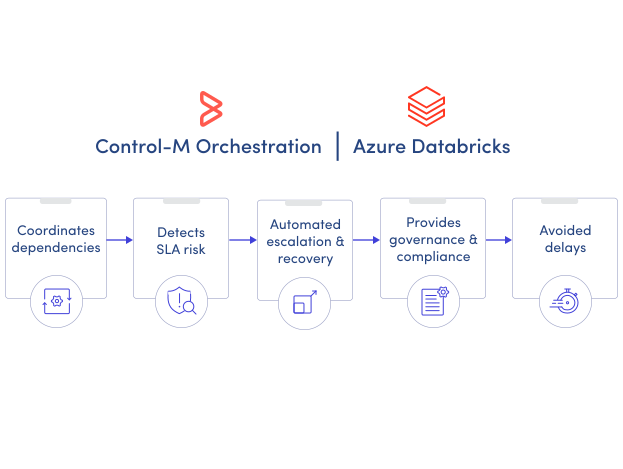
SLA-SICHERUNG
Wiederherstellen Sie Azure Databricks-Workflows, ohne die Pipeline neu zu bauen.
Native Job-Wiederholungen lösen einzelne Ausführungsfehler, koordinieren aber nicht die Wiederherstellung über abhängige Systeme hinweg. Control-M automatisiert Wiederholungen, verwaltet plattformübergreifende Abhängigkeiten, verhindert nachgelagerte Ausfälle und nimmt Arbeitsabläufe vom entsprechenden Wiederherstellungspunkt wieder auf:
-
Konfigurierbare Wiederholungsrichtlinien
-
Abhängigkeitsbewusste Wiederherstellung
-
Downstream-Kaskadenprävention
-
Automatisierte Ausnahmebehandlung
-
Politikbasierte Benachrichtigungen
Documentation
Bring Ordnung in komplexe Arbeitsabläufe
Erfahren Sie, wie Control-M Teams hilft, komplexe Prozesse mit größerer Transparenz, Koordination und Kontrolle zu orchestrieren.
